

June 2026
A major new European Commission report has put women’s entrepreneurship in Europe under the spotlight. For Enterprise Evolution, the findings are both timely and relevant to our work, specifically in relation to the EPIC-X Programme. This pioneering initiative is currently supporting 20 female-led deep tech start-ups from countries classified as “moderate” and “emerging” innovators, distributing a total of €1.2M to accelerate their growth and impact. 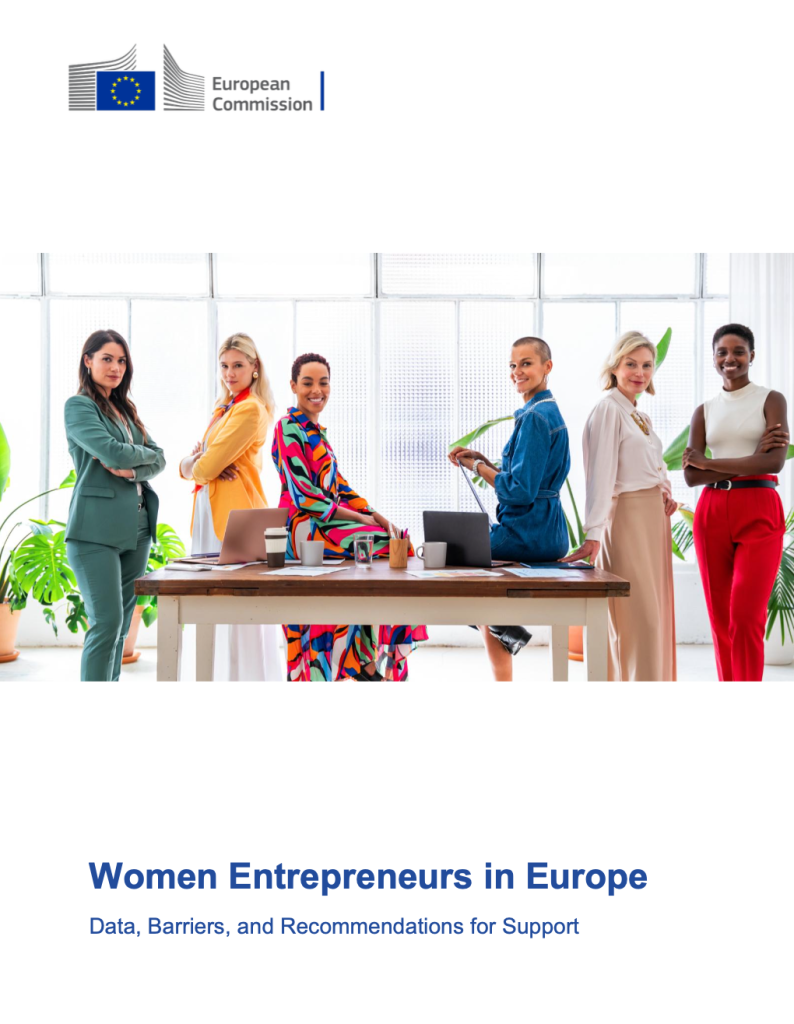
Published by the European Innovation Council and SMEs Executive Agency (EISMEA), Women Entrepreneurs in Europe: Data, Barriers, and Recommendations for Support (2026) draws on data from 39 European countries. It maps where women entrepreneurs are thriving, where barriers remain, and which policy responses are working. Read more to find out why the Gender Entrepreneurship Gap persists and what needs to change to close it.
The Gender Entrepreneurship Gap
The gender entrepreneurship gap across the EU is significant and persistent. Women make up just 33% of all entrepreneurs in the EU-27. Only 7% of women across 18 EU countries are engaged in early-stage entrepreneurial activity. That compares to 10% of men. Researchers estimate this gap represents around 4 million “missing” women entrepreneurs across the EU.
The report identifies barriers that appear consistently across countries. Women are more likely than men to cite fear of failure (53% vs 45%). They are less likely to feel they have the skills to start a business (42% vs 55%). They are also far more likely to work as solo entrepreneurs (74% vs 66%), and twice as likely to work part-time (24% vs 11%).
These are not small gaps. They are structural. Moreover, they vary significantly across Europe. Below, we look at what the data shows for some of the countries we work with through EPIC .
Why Closing This Gap Matters
The economic case is clear. Research consistently shows that women-led businesses perform strongly. They tend to deliver higher returns on investment, build more diverse teams, and reinvest more in their communities. When women cannot access entrepreneurship equally, Europe loses that value entirely. We also lose the solutions, products, and services that women would build. So why does the gender entrepreneurship gap in Europe persist?
Many of the biggest challenges we face, whether in health, care, sustainability, and social inclusion. These are areas where women entrepreneurs are already leading. So unequal participation does not just limit individual opportunity. It limits collective progress.Furthermore, the innovation argument is compelling. This report shows that in several countries, women are already out-innovating men. Yet they face higher barriers to entry, less access to finance, and weaker support networks. That means a significant share of Europe’s innovation potential simply does not reach the market. Closing the gap is therefore not just a matter of fairness. It is a matter of economic competitiveness.
Spotlight: Moderate Innovator Countries
Lithuania: Where Women Lead
Lithuania stands out across the EU for one remarkable reason. It is the only country where women’s early-stage entrepreneurship rate exceeds men’s: 7% for women versus 6% for men. Women also make up 38% of all entrepreneurs, which is above the EU average of 33%.
Furthermore, Lithuanian women report higher rates of innovative business activity than men (8% vs 4%). That is a significant reversal of the EU-wide trend. The report also highlights Lithuania’s individual income tax system as a structural enabler. It reduces the “second earner penalty” that discourages many women from full-time entrepreneurial activity.
However, 93% of women entrepreneurs work as solo operators. Mean net income sits at just €14,000. So there is clear scope to support Lithuanian women to scale, and EPIC X is designed to do exactly that.
Italy: The Innovation Paradox
Italy presents one of the most striking paradoxes in the report. Italian women entrepreneurs report the highest rate of innovative business activity in the EU. Specifically, 57% describe their businesses as offering new or significantly improved products or services. That is well above the EU-18 average of 41%, and it outpaces Italian men, who report 51%.
Yet women remain significantly underrepresented in entrepreneurship overall. Just 31% of Italian entrepreneurs are women. Only 6% of women are active in early-stage entrepreneurship, compared to 10% of men. In addition, only 15% of Italian women say it is easy to start a business, one of the lowest figures in Europe.
In short, Italy’s women entrepreneurs are innovating despite the system, not because of it. Removing structural barriers to entry could unlock enormous economic potential.
Croatia: A Confidence Story
Croatia records the highest rate of women reporting they have the skills to start a business of any EU country: 70%. That is well above the EU average of 42%. Both women’s and men’s early-stage entrepreneurship rates also sit above the EU average (10% for women, 16% for men).
So the confidence is there. The focus for EPIC X in Croatia is converting that confidence into greater representation and scale. Women still make up only 30% of entrepreneurs, and 60% work as solo operators.
Spotlight: Emerging Innovator Countries
Latvia: High Ambition, Real Momentum
Latvia has the third highest share of women entrepreneurs in the EU at 40%. It also records the highest women’s early-stage entrepreneurship rate of any EU country: 12%. That speaks to a genuinely entrepreneurial culture among Latvian women.
Notably, 50% of Latvian women entrepreneurs cite “making a difference” as their motivation for starting a business. That is the highest such rate in Europe. In addition, 8% aim for high growth, meaning 20 or more employees within five years. However, 30% work part-time and mean net income is just €11,000. So high activity rates do not automatically translate into economic security or scale.
Latvia is a country where the energy clearly exists. The infrastructure for growth needs to catch up.
Slovakia: Women Out-Innovating Men
Slovakia shows one of the most compelling gender innovation reversals in Europe. 40% of Slovak women entrepreneurs report innovative business activity, compared to just 23% of men. That is a 17 percentage point gap in women’s favour, and the widest pro-female innovation gap in the EU.
Nevertheless, Slovak women are underrepresented in entrepreneurship overall at 26%. 85% work as solo operators and mean net income is just €9,000. Despite that innovation energy, no Slovak women entrepreneurs in the sample report high-growth ambitions.
That combination matters. Women are innovating without the ecosystem or support frameworks to scale. This is precisely the gap that EPIC X partners are positioned to address.
Romania: The Optimism-Reality Gap
Romania records the lowest share of women entrepreneurs in the EU-27 at just 24%. Mean net income is also the lowest in the report at €3,000. 90% of women entrepreneurs work as solo operators. The report also notes that 94% started their business because employment opportunities were scarce. For many, entrepreneurship is survival, not opportunity.
And yet, Romanian women are more optimistic about business opportunities than Romanian men (57% vs 54%), and more optimistic than the EU average overall. That optimism, in the face of real structural disadvantage, is striking.
Therefore, Romania is perhaps the clearest case in the EPIC X cohort for why targeted support matters. The conditions for women’s entrepreneurship are among the most challenging in Europe, but the aspiration is there.
What This Means for EPIC-X
Enterprise Evolution delivers the EPIC X programme as part of a consortium of leading women’s enterprise support organisations across Europe. The programme builds the capacity of intermediary organisations that support women entrepreneurs in these contexts.
This report validates both the need for that work and the approach behind it. Across Moderate and Emerging Innovator countries alike, the data points to the same conclusion. Women’s entrepreneurship potential in Europe is not constrained by a lack of ambition, innovation, or capability. Rather, it is constrained by structural barriers, insufficient support, and limited access to growth ecosystems.
The report calls for tailored, country-sensitive support models; better gender-disaggregated data; removal of tax disincentives; and investment in entrepreneurship education and mentorship. Through EPIC X, Enterprise Evolution and our partners are building the capacity across Europe to deliver exactly that.
Read the Full Report: Women Entrepreneurs in Europe: Data, Barriers, and Recommendations for Support is available from the Publications Office of the European Union.
Enterprise Evolution is a dynamic social enterprise dedicated to fostering business creation, growth, social impact, innovation, and inclusion. We are proud partners in the EPIC X Horizon Europe Widening Programme.



Leave A Comment