

What is a theory of change, and why does my organisation need one?
Often, we make plans for our business; we have certain things we want to achieve and goals we are working towards. More commonly, though, these drivers are a shared vision, one that we talk about or muse on, but haven’t actually spent time writing down and planning.
That’s where the need for a theory of change (ToC) comes into play. Similarly to how, when we set goals at New Year’s, we may be loose and vague, those goals often get forgotten or shrugged off. However, if we spend time writing SMART or even SMARTER goals, we are much more likely to achieve them, because we have created a way to measure and monitor our success.
Ultimately, a theory of change can be written or reviewed at any time, and it is good practice to check it regularly. It can also be a shared vision between you and your team of where you are headed, your priorities, and where you might want to capture your social value. Yes, that’s right – a theory of change can help you capture your social value too!
The five parts of a theory of change
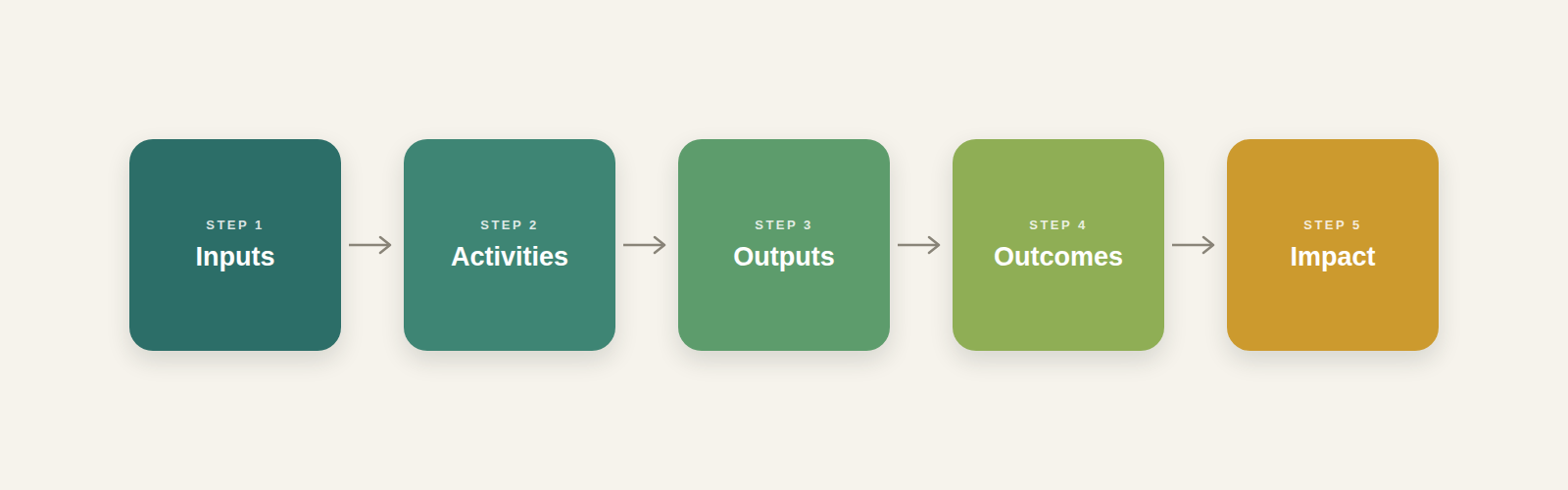
So you’re convinced – you need a theory of change. How do you actually do it? The theory of change (or ToC, as it shall now be known) consists of five parts:
- Inputs
- Activities
- Outputs
- Outcomes
- Impact
It’s usually best to start at the end, with your impact. In other words: what is the impact you want to make? What is the problem you solve? What is the difference your organisation is making?
From there, go back to your inputs: what does your organisation need to make that impact? Most likely, this will be funding, staff, equipment, and so on.
Next, come the activities: what are the physical things your organisation does to create change? For example, running workshops, having a support line, or providing a product or service.
Outputs vs outcomes: what’s the difference?
At this point, it’s easy to get confused between outputs and outcomes, so let’s take a minute to break down what they actually mean.
Outputs are the tangible results of an activity – for instance, the number of people who attended a workshop or engaged with a service.
Outcomes, on the other hand, are the less tangible result: the human impact, the bigger picture, the ‘what happened next’. Did a participant go on to get a job? Did their confidence increase? Did they do something else as a result of taking part in your services? This can be harder to measure, but it is worth doing, as it shows the real impact your services are having in a community.
Once you’ve recorded your outputs and outcomes, that leads you back to where you started: your impact.
ToC in action: a worked example
To bring this to life, here’s how a theory of change might look for a community project.
Goal: Reduce loneliness in my local community by providing a weekly collage club for people aged 17+, creating opportunities for social connection, creativity and belonging.
Inputs: To achieve this goal, you would first need:
- A suitable community venue
- Funding for materials (magazines, paper, scissors, glue, etc.)
- Public liability insurance
- Volunteers to support delivery and participant engagement
- Promotion and outreach to attract participants
Activities
With those inputs in place, the activities themselves would include:
- Delivering weekly collage workshops in a welcoming and inclusive environment
- Encouraging conversation, collaboration and peer support during sessions
- Signposting participants to other local activities and opportunities where appropriate
Outputs
As a result of these activities, you could then measure outputs such as:
- Number of workshops delivered
- Number of participants attending
- Number of repeat attendees
- Number of volunteer hours contributed
Outcomes
Beyond those numbers, though, come the outcomes – the deeper, human changes that unfold in the short and medium term.
In the short term:
- Participants develop new creative skills and confidence
- Increased social interaction and reduced feelings of isolation
- New friendships and social connections formed
Over the medium term:
- Participants feel a stronger sense of belonging in their community
- Increased participation in other community activities
- Improved wellbeing and self-esteem
Impact
Taken together, all of this builds towards a more connected, inclusive and resilient local community – one where people experience less loneliness, have stronger social networks, and feel empowered to participate in community life.
Using your theory of change to measure social value
So, does this sound like something you’d like to try? If you’re still not convinced, remember how we mentioned it can help you measure your social value?
By understanding your outputs and outcomes, you are essentially planning what data you need to collect. For example, if you have registers showing how many people attended, you could present this as evidence for your outputs. Likewise, if you implement a survey measuring your service users’ confidence before they engage with you, and then again afterwards, you can see whether your activities have made any significant difference.
You might also consider scheduling time to speak to those who engaged with your services three or six months later, to see whether their engagement led to a bigger outcome. By collecting this data, you build a clear picture of your social value – and, in turn, can show your funders and stakeholders just how much you are worth as an organisation.
At Enterprise Evolution, we help organisations bring their vision to life by measuring, tracking, and proving their social value. If you want to turn your long-term goals into clear impact, click here to find out more about our social impact expertise.
Written by Enterprise Evolution associate Roz Dean




Leave A Comment